The third (and final?) meeting on the proposed conversion of the Poultry CAFO to a Veal Calf CAFO will be held tomorrow, Dec. 27, 2006, at 7:00 pm CST at the Jasper County Fairgrounds ... where the BZA will announce their decision on the Special Exception Permit requested by Mark Shuringa and Gilbert Den Dulk.
As the next meeting approaches and the year 2006 is quickly coming to an end, I'd like to look hopefully to the new year ahead as being the "year of responsibility and accountability" in regards to CAFOs -- both present and proposed for our State.
This past year, it was the Food Industry that had to step up to the plate and answer serious questions regarding food safety. However, the E. coli outbreaks (from contaminated spinach and contaminated lettuce) have been steadily drawing attention "back to the farm" -- where some experts believe public health and safety is increasingly at higher risk.
Manure is becoming a serious issue, not just as it relates to environmental pollution, but also as it relates to public health risks. For example, "More than 150 known enteric pathogens may be present in the untreated wastes, and one new enteric pathogen has been discovered every year over the past decade." (link)
The general population is just now waking up to what has been happening to farming over the past few decades. What will they think when they start learning more? (Read this report regarding emerging food-borne diseases.)
What pressures will people place on governments everywhere in regards to accountability and responsibility? The Farm Bill of Rights may give several environmental and nuisance protections to the Big Agriculture ...but I sincerely believe people won't let it stand in the way of public health and safety issues.
At this next Jasper County BZA meeting, a pivotal decision will be made affecting Walker Township.
Meanwhile, the year 2007 could be the year where "hoosiers" everywhere step up to the plate to remind public officials who they really work for in Indiana. And it just might be the year Mitch Daniels receives his wake-up call.
See you tomorrow night.
Tuesday, December 26, 2006


Wednesday, December 20, 2006
Senator Brandt Hershman weighs in on the CAFO issue
Just when you think no one is listening... when you think you're all alone, feeling like David facing Goliath, at least one Government representative is stepping up to the plate.
Meet Senator Brandt Hershman: Majority Caucus Whip
He's on the following Committees:
- Utilities & Regulatory Affairs, Chairman
- Rules & Legislative Procedure, R.M.
- Tax & Fiscal Policy
- Energy & Environmental Affairs
- Agriculture & Small Business
And in his own words quoted from this letter, he states, QUOTE:
Although I take exception with his wording that... "A number of CAFO’s have been approved in Jasper County with little or no opposition, primarily, I believe, due to the rural character of the tracts." (Where was he when thousands of people protested the HOG CAFO that went in 2500 feet from my front steps??) ...still, I'm glad he -- at least -- appreciates the fact that this is definitely THE WRONG SITE to place a veal calf operation!
Meet Senator Brandt Hershman: Majority Caucus Whip
He's on the following Committees:
- Utilities & Regulatory Affairs, Chairman
- Rules & Legislative Procedure, R.M.
- Tax & Fiscal Policy
- Energy & Environmental Affairs
- Agriculture & Small Business
And in his own words quoted from this letter, he states, QUOTE:
"As someone with a 150 year family history in agriculture and a clear understanding of the challenges facing the successful merging of residential growth and preserving our agricultural heritage, I understand the difficulty you face with respect to the Schuringa CAFO. To this point, I have not expressed a position on the issue because of my respect for the role of the BZA in making this decision. However, comments made at the recent public forum regarding my sponsorship of Indiana's agricultural nuisance law may have given the appearance that I support the application for a special exception. For the record, I do not support the exception."Does this mean we're actually being heard this time? It appears Senator Hershman has been doing some research on the subject of this CAFO, as he further states in the document -- QUOTE:
"A number of CAFO’s have been approved in Jasper County with little or no opposition, primarily, I believe, due to the rural character of the tracts. This is not the case with the Schuringa application. While much discussion has focused on the newer subdivisions in the area, and their written acceptance of agricultural operations via covenants, these new homes represent only a small percentage of the homeowners in the area. Twenty eight subdivisions with approximately 500 lots exist within 1.5 miles of the Schuringa farm. Many of these homes are located in residentially zoned areas, and pre-date the construction of the poultry CAFO. Their interests need to be considered as well."Again, many people have been under the mistaken assumption that most residents in the area of this proposed Special Exception are new to the area. Just as our family is not new to this area, in fact 5 generations of our family have resided in this very same home, many of the subdivisions in the near vicinity of this particular proposed veal calf CAFO have also been around long before the poultry farm ever existed.
Although I take exception with his wording that... "A number of CAFO’s have been approved in Jasper County with little or no opposition, primarily, I believe, due to the rural character of the tracts." (Where was he when thousands of people protested the HOG CAFO that went in 2500 feet from my front steps??) ...still, I'm glad he -- at least -- appreciates the fact that this is definitely THE WRONG SITE to place a veal calf operation!
Tuesday, December 19, 2006
Property Values & the CAFO spin
Last Monday, at the BZA meeting, I recall a pro-CAFO comment indicating property values don't decline... that many values actually increased around Fair Oaks.
I don't know about that. But what I do know is this...
While the hog CAFO was under construction, we had an appraiser at our house -- this was before the construction was complete, before the BZA made it's final decision, before they sealed the fate of our property value.
The appraiser gave us a "ballpark" estimate while in our home. It was significantly higher than the previous estimate back in the late 90's -- due to the tremendous amount of work my husband had completed on our home. His is a labor of love... as I mentioned previously, this home and land has been in his family for 5 generations now.
But, the appraiser said he had to check surrounding values before committing any estimate to writing.
A month rolled by... then two... the hog farm got its Special Exception permit and was open for business ...and still we hadn't heard from the appraiser. Several months later after numerous requests for the written appraisal, the appraiser sent our money back. He could not hold to his previous estimate in writing.
So please, don't tell me a CAFO has no negative effects on nearby residential property values.
But, for those of you living near a CAFO, did you know about the "Right of Exclusion" laws in the USA? This is information that even surprised me when I started reading through it today. Quote:
"Right of ExclusionInteresting... Here's the link for those wishing to learn more.
The right of exclusion -- often called the right of exclusive use or right of exclusive enjoyment -- provides that those who have no claim on property should not gain economic benefit from enjoyment of the property.
In other words, the right of use is exclusive to the property owner, and any violation of the right of exclusive use typically carries either payment of compensation to the rightful owner or assessment of a penalty. For example, if "A" trespasses on land owned by "B," then "A" will be guilty of a crime and a possible criminal penalty may be in order, as well as civil damages. Physical impairment, such as the odor or flies, in effect is a trespass on property rights and violates the right of exclusion.
Society places a high value on the right of exclusion, for justifiable reasons. Exclusion provides that both the current benefits of ownership as well as future benefits accrue only to the rightful owner, and his/her successors and assigns.
In the absence of exclusion, the right of use is under constant threat of nullification without just compensation. In an economy without the right of exclusion, property owners would adopt short-term strategies for use, rather than long-term strategies. In an economic sense, this would lead to widespread inefficiency in the allocation of resources.
Hence, the right of exclusion carries with it a significant societal good, and thus a significant, societally recognized Value."
Sunday, December 17, 2006
"An Angry Mop"
The day after the Dec. 11, 2006 BZA meeting, our little boy was playing one of many computer strategy games on my husband's computer. I was in the kitchen when I heard him chanting loudly...
"Angry mop! Angry mop! Angry mop!"
I thought, "What in the world...?"
When I asked him, he explained,
"See that group of good guys? That's a angry mop. See that group of bad guys? That's a angry mop, too. The angry mops get together and fight and that's how I win the game..."
In a 6-year-old's mind, an angry mop can solve a lot.
As a housewife, I have a different vision of what an angry mop is. It's when you tackle the floors in your house with a heavy mop. After you've finished, you're left with sparkling clean floors and an incredlibly fresh smelling house.
But I digress...
I went to the meeting last Monday night -- not to fight -- but to watch, to listen, and to learn.
Here's what I learned from the meeting:
1. The proposed facility is intended to be a veal calf operation, not a dairy calf operation... although it may house some dairy heifers in addition to mostly male calves.
This is important information for several reasons, some of which I will be writing about in the weeks ahead.
2. The watershed in our area is unique ...and apparently very precious and rare... as the hydrology expert pointed out in his presentation. Even though I already knew many of us are forced to use shallow wells owing to the geological make-up of our area, I had no idea our aquifer is that close to the land's surface.
It's more fragile than even I had first considered... and gives me even more consternation about the health risk potential any CAFO brings to our region.
The recent e. coli in spinach scare comes to mind.
As does the Walkerton, Ontario incident in 2000 where 6 people died...
And the Cryptosporidium parvum outbreak in Milwaukee, WI, 1993 from which it's estimated 50 to 70 people died...
and other equally disturbing cases.
To a mother with a young child... hearing this information about our aquifer, seeing it presented so clearly ...my protective instincts were "silently screaming" inside.
I simply can't help thinking how crazy it is to allow tens of thousands of tons of bacteria-laden manure to be dumped every year on that shallow shell of sand and gravel separating us from our water -- millions of tons when you consider some of the other CAFOs that have already forced their way in here amidst public protest. In my humble opinion -- it's insane!!
Where are the public health officials in all of this?! Who is protecting us???
3. I also learned that, although the amount of major nutrients (nitrogen, phosphorus and potassium) will not increase by the switch from 350,000 poultry (actually 345,500) to 10,000 calves, the overall volume of manure will increase.
By how much?
I wasn't sure, because the numbers presented were for a dairy operation, so I requested further info from the Purdue expert that attended the BZA meeting. The answer I received indicated that there would be, a whopping 241% increase in the volume of manure!!
Quote:
4. I learned there are a great many more people in this area that are opposed to the calf operation than I had first thought, as evidenced by the number of people who showed up, and many who lined up at the mic to express their opposition publicly for the record.
5. I learned that some members of the BZA did not appear very interested in much of the information presented by groups in opposition to the calf CAFO, and that they could be quite obvious about it -- astonishingly obvious.
Their lack of respect towards many of the presenters and the citizens in attendance was pointed out in a very severe reprimand given to some members of the BZA panel by a member of the Wheatfield planning board. His comments stated "for the record" were followed by very loud cheers from the audience.
Now, I had to leave the meeting on 2 occasions.
Once, when the lawyer for one of the CAFO-opposition groups got up to do his presentation. My son was extremely restless, and before he could become disruptive to those sitting near us, I left with him so he could get a drink of water and get some fresh air outside.
I wish I could have heard everything the lawyer had to say. My apologies for not being able to bring you specifics on his presentation.
We returned near the end of the lawyer's presentation... and sat by ourselves at the back of the auditorium so as not to disturb those down in front. My husband remained down in front, closer to the stage.
The second time was when people lined up to voice their stance publicly for the record with their 2-minute time alotment "granted" by the BZA speaker. After about 50 or 60 people had their say, my son, who had just woken up from a brief nap "had to go" ...most parents out there know what that means.
Sidenote: My son was woken up by the booming voice of the BZA speaker shouting at the audience yet again, trying so desperately to make it appear as though he had an unruly mob on his hand. He's a strange man, that one.
I rushed to the front to tell my husband I would be taking our son to the washroom and then out to wait in the truck.
We were both asleep in the truck when my husband appeared about an hour later. The meeting still wasn't over... that was close to midnight. Needless to say, we had to get our son home to bed.
So we missed the private conference held onstage ...and the final announcement that the Special Exception Permit would be "tabled" until a later date -- Dec. 27th, according to one astute reporter who got a picture of the "private mics-off mini conference" held on the stage.
Hmmmm... There are some Govt. appointed officials that could lose their jobs for doing that at a public meeting in Canada. It's interesting to see the differences between Canadian laws for public meetings and USA laws.
Now, back to the "angry mop" thing...
A cell phone rang out in the auditorium late in the meeting (before I left with our son) at which point the BZA Speaker harshly reprimanded the citizens about turning off their cell phones -- again trying to sound like he was addressing an unruly angry mob. Sheesh! He should have been an actor. The police officer who answered the call on his cell phone was out in the hall at the time of the reprimand.
I left the meeting with more questions ringing in my mind that I think need to be "cleaned up" with an angry mop. Questions like,
1. Why is it that every time the BZA speaker chose to rebuke the audience, his eyes fell on those opposed to the CAFO, and avoided the small group of CAFO supporters near the front? Was this a "grandstanding" play? He must have felt very powerful, indeed. I think he needs to clean up his act.
2. Why is it that one specific BZA member can stubbornly refuse to watch ANY AND ALL presentations brought forth by experts called on behalf of those opposing the operation ...and then still be allowed to vote on whether or not this calving operation can proceed? His attitude was extremely childish, in my humble opinion. Who appointed him to the Board? I think they need to clean house and replace him, and possibly replace the govt. official who appointed him.
2. Why were 4 policemen -- yes, FOUR -- called to be in attendance? Are they trying to make out like we're nothing but an angry mob? Sure, applause became loud on occassion. And yes, even a few pro-CAFO people who stepped up to the mic were interrupted by rumblings from the crowd ...but I can assure you, even though everyone living near the planned calving CAFO are clearly upset by the threats they perceive this CAFO will bring to this community, they were NOT in ANY WAY acting like an irrational angry mob. Who specifically requested 4 police officers? And why?
3. What are the REAL plans for this calving CAFO? You see, they have applied for an IDEM permit that indicates they will have 5,000 calves. Then they present to the BZA meeting that they intend to have 10,000 -- 5,000 in the existing poultry barns (after modifications to the barns are made) plus another 5,000 to be housed elsewhere on the property.
And I got really tired of how, almost gleefully, the CAFO lawyer pointed out that residents and property ownders in the two subdivisions in the immediate vicinity of this CAFO signed waivers of their rights to complain regarding agricultural operations. It's like he completely ignored the rest of us residents who signed absolutely nothing at all.
I'm still not clear on where they plan to house the additional 5,000 calves, or what their true intentions are for this calving operation.
I think the CAFO owners need to "clean up their act" and submit clear, specific plans outlining their intentions for this CAFO as well as more detailed and specific information regarding their plans of operation for minimizing their impact on area residents and their public health-risk prevention measures. The tree buffer was a nice touch, but it comes nowhere close to addressing potential risks and/or threats to our water, in my humble opinion...
I hate that moronic "easy-out" about their intent to use "best management practices" as per state guidelines. That doesn't tell me a thing in regards to the unique -- and rare -- nature of our acquifer. Maybe they addressed it after I left?
4. And another question... Who is really going to be the owner/operator of this operation? Is it going to be a partnership between Mark Shuringa and Gilbert den Dulk? Relatives and/or family friends of Mark Shuringa swear he has nothing to do with the calving operation... that he's just trying to sell off his egg farm because it has suffered severe financial losses in recent years.
Do the other Den Dulk operations (such as their Michigan farms and their Fair Oaks farms) have anything to do with ownership and/or overseeing this operation?
Speaking to one reporter recently, the reporter mentioned that Gilbert den Dulk swears this CAFO has nothing to do with the other Den Dulk operations -- that it's not related in any way. And yet, at the meeting I'm quite certain I heard the CAFO lawyer state that the calves would be coming from many places, including Fair Oaks and Michigan.
5. And lastly for this blog post, but not the last of the many questions I have remaining, particularly in regards to the bacteria in that mountain of manure -- 241% more manure -- why is it that 5 people who don't live anywhere near to my home have the power to decide whether or not my family is put in harms way?
In a democracy, majority rules -- doesn't it?
If we put it to a referendum in this area for people residing in Walker Township to vote on, do you think this CAFO would be approved?
In my personal and humble opinion, I think we need to take an "angry mop" to laws currently in place here in Jasper County, and in other Indiana counties ...change laws that seem to fail miserably in the areas of prevention, and in some cases even strip residents of their rights ...maybe we should require that CAFO approvals go to a referendum and not be left in the hands of people who don't live anywhere near where they are to be located ...clean house to better serve and protect public health and public interests.
"Angry mop! Angry mop! Angry mop!"
I thought, "What in the world...?"
When I asked him, he explained,
"See that group of good guys? That's a angry mop. See that group of bad guys? That's a angry mop, too. The angry mops get together and fight and that's how I win the game..."
In a 6-year-old's mind, an angry mop can solve a lot.
As a housewife, I have a different vision of what an angry mop is. It's when you tackle the floors in your house with a heavy mop. After you've finished, you're left with sparkling clean floors and an incredlibly fresh smelling house.
But I digress...
I went to the meeting last Monday night -- not to fight -- but to watch, to listen, and to learn.
Here's what I learned from the meeting:
1. The proposed facility is intended to be a veal calf operation, not a dairy calf operation... although it may house some dairy heifers in addition to mostly male calves.
This is important information for several reasons, some of which I will be writing about in the weeks ahead.
2. The watershed in our area is unique ...and apparently very precious and rare... as the hydrology expert pointed out in his presentation. Even though I already knew many of us are forced to use shallow wells owing to the geological make-up of our area, I had no idea our aquifer is that close to the land's surface.
It's more fragile than even I had first considered... and gives me even more consternation about the health risk potential any CAFO brings to our region.
The recent e. coli in spinach scare comes to mind.
As does the Walkerton, Ontario incident in 2000 where 6 people died...
And the Cryptosporidium parvum outbreak in Milwaukee, WI, 1993 from which it's estimated 50 to 70 people died...
and other equally disturbing cases.
To a mother with a young child... hearing this information about our aquifer, seeing it presented so clearly ...my protective instincts were "silently screaming" inside.
I simply can't help thinking how crazy it is to allow tens of thousands of tons of bacteria-laden manure to be dumped every year on that shallow shell of sand and gravel separating us from our water -- millions of tons when you consider some of the other CAFOs that have already forced their way in here amidst public protest. In my humble opinion -- it's insane!!
Where are the public health officials in all of this?! Who is protecting us???
3. I also learned that, although the amount of major nutrients (nitrogen, phosphorus and potassium) will not increase by the switch from 350,000 poultry (actually 345,500) to 10,000 calves, the overall volume of manure will increase.
By how much?
I wasn't sure, because the numbers presented were for a dairy operation, so I requested further info from the Purdue expert that attended the BZA meeting. The answer I received indicated that there would be, a whopping 241% increase in the volume of manure!!
Quote:
"Using manure production numbers provided by the Midwest Plan Service, we estimate total manure production to be as follows:In other words, you can expect the total volume of contaminants to increase by 241% ...in an area where the watershed lays very close to the land surface.
350,000 Laying Hens = 9,581 tons/year
10,000 Beef Calves= 32,712 tons/year (i.e., +241% increase)
Please note that the amount of major nutrients (nitrogen, phosphorus and potassium) will not increase; however, the mass of the manure, heavy metal, antibiotics, hormones, etc., are all likely to increase."
4. I learned there are a great many more people in this area that are opposed to the calf operation than I had first thought, as evidenced by the number of people who showed up, and many who lined up at the mic to express their opposition publicly for the record.
5. I learned that some members of the BZA did not appear very interested in much of the information presented by groups in opposition to the calf CAFO, and that they could be quite obvious about it -- astonishingly obvious.
Their lack of respect towards many of the presenters and the citizens in attendance was pointed out in a very severe reprimand given to some members of the BZA panel by a member of the Wheatfield planning board. His comments stated "for the record" were followed by very loud cheers from the audience.
Now, I had to leave the meeting on 2 occasions.
Once, when the lawyer for one of the CAFO-opposition groups got up to do his presentation. My son was extremely restless, and before he could become disruptive to those sitting near us, I left with him so he could get a drink of water and get some fresh air outside.
I wish I could have heard everything the lawyer had to say. My apologies for not being able to bring you specifics on his presentation.
We returned near the end of the lawyer's presentation... and sat by ourselves at the back of the auditorium so as not to disturb those down in front. My husband remained down in front, closer to the stage.
The second time was when people lined up to voice their stance publicly for the record with their 2-minute time alotment "granted" by the BZA speaker. After about 50 or 60 people had their say, my son, who had just woken up from a brief nap "had to go" ...most parents out there know what that means.
Sidenote: My son was woken up by the booming voice of the BZA speaker shouting at the audience yet again, trying so desperately to make it appear as though he had an unruly mob on his hand. He's a strange man, that one.
I rushed to the front to tell my husband I would be taking our son to the washroom and then out to wait in the truck.
We were both asleep in the truck when my husband appeared about an hour later. The meeting still wasn't over... that was close to midnight. Needless to say, we had to get our son home to bed.
So we missed the private conference held onstage ...and the final announcement that the Special Exception Permit would be "tabled" until a later date -- Dec. 27th, according to one astute reporter who got a picture of the "private mics-off mini conference" held on the stage.
Hmmmm... There are some Govt. appointed officials that could lose their jobs for doing that at a public meeting in Canada. It's interesting to see the differences between Canadian laws for public meetings and USA laws.
Now, back to the "angry mop" thing...
A cell phone rang out in the auditorium late in the meeting (before I left with our son) at which point the BZA Speaker harshly reprimanded the citizens about turning off their cell phones -- again trying to sound like he was addressing an unruly angry mob. Sheesh! He should have been an actor. The police officer who answered the call on his cell phone was out in the hall at the time of the reprimand.
I left the meeting with more questions ringing in my mind that I think need to be "cleaned up" with an angry mop. Questions like,
1. Why is it that every time the BZA speaker chose to rebuke the audience, his eyes fell on those opposed to the CAFO, and avoided the small group of CAFO supporters near the front? Was this a "grandstanding" play? He must have felt very powerful, indeed. I think he needs to clean up his act.
2. Why is it that one specific BZA member can stubbornly refuse to watch ANY AND ALL presentations brought forth by experts called on behalf of those opposing the operation ...and then still be allowed to vote on whether or not this calving operation can proceed? His attitude was extremely childish, in my humble opinion. Who appointed him to the Board? I think they need to clean house and replace him, and possibly replace the govt. official who appointed him.
2. Why were 4 policemen -- yes, FOUR -- called to be in attendance? Are they trying to make out like we're nothing but an angry mob? Sure, applause became loud on occassion. And yes, even a few pro-CAFO people who stepped up to the mic were interrupted by rumblings from the crowd ...but I can assure you, even though everyone living near the planned calving CAFO are clearly upset by the threats they perceive this CAFO will bring to this community, they were NOT in ANY WAY acting like an irrational angry mob. Who specifically requested 4 police officers? And why?
3. What are the REAL plans for this calving CAFO? You see, they have applied for an IDEM permit that indicates they will have 5,000 calves. Then they present to the BZA meeting that they intend to have 10,000 -- 5,000 in the existing poultry barns (after modifications to the barns are made) plus another 5,000 to be housed elsewhere on the property.
And I got really tired of how, almost gleefully, the CAFO lawyer pointed out that residents and property ownders in the two subdivisions in the immediate vicinity of this CAFO signed waivers of their rights to complain regarding agricultural operations. It's like he completely ignored the rest of us residents who signed absolutely nothing at all.
I'm still not clear on where they plan to house the additional 5,000 calves, or what their true intentions are for this calving operation.
I think the CAFO owners need to "clean up their act" and submit clear, specific plans outlining their intentions for this CAFO as well as more detailed and specific information regarding their plans of operation for minimizing their impact on area residents and their public health-risk prevention measures. The tree buffer was a nice touch, but it comes nowhere close to addressing potential risks and/or threats to our water, in my humble opinion...
I hate that moronic "easy-out" about their intent to use "best management practices" as per state guidelines. That doesn't tell me a thing in regards to the unique -- and rare -- nature of our acquifer. Maybe they addressed it after I left?
4. And another question... Who is really going to be the owner/operator of this operation? Is it going to be a partnership between Mark Shuringa and Gilbert den Dulk? Relatives and/or family friends of Mark Shuringa swear he has nothing to do with the calving operation... that he's just trying to sell off his egg farm because it has suffered severe financial losses in recent years.
Do the other Den Dulk operations (such as their Michigan farms and their Fair Oaks farms) have anything to do with ownership and/or overseeing this operation?
Speaking to one reporter recently, the reporter mentioned that Gilbert den Dulk swears this CAFO has nothing to do with the other Den Dulk operations -- that it's not related in any way. And yet, at the meeting I'm quite certain I heard the CAFO lawyer state that the calves would be coming from many places, including Fair Oaks and Michigan.
5. And lastly for this blog post, but not the last of the many questions I have remaining, particularly in regards to the bacteria in that mountain of manure -- 241% more manure -- why is it that 5 people who don't live anywhere near to my home have the power to decide whether or not my family is put in harms way?
In a democracy, majority rules -- doesn't it?
If we put it to a referendum in this area for people residing in Walker Township to vote on, do you think this CAFO would be approved?
In my personal and humble opinion, I think we need to take an "angry mop" to laws currently in place here in Jasper County, and in other Indiana counties ...change laws that seem to fail miserably in the areas of prevention, and in some cases even strip residents of their rights ...maybe we should require that CAFO approvals go to a referendum and not be left in the hands of people who don't live anywhere near where they are to be located ...clean house to better serve and protect public health and public interests.
Tuesday, December 12, 2006
Quick BZA Meeting update
Here's the first news article link I've receieved regarding last night's BZA Meeting.
The article begins:
The article begins:
"RENSSELAER - The Jasper County Board of Zoning Appeals voted at the end of a heated five-hour meeting Monday night to table a proposal that would allow an enclosed farm to change ownership and switch from chicken to calf production.Super busy here today... I'll be back later with my personal comments.
"There was just too much information given for them to make a good decision," said Pat Price, 54, of DeMotte.
The decision proved anticlimactic for the dwindling crowd, which began the evening by filling nearly to capacity Rensselaer Central High School's 600-seat auditorium. The venue was chosen after the board's vote, originally scheduled for Nov. 13, was postponed and moved from the Jasper County Courthouse due to an unexpectedly high turnout.
The board will again attempt to vote on the matter Dec. 27 at the Jasper County Fairgrounds."
Monday, December 11, 2006
Jasper County CAFO BZA Meeting Tonight
The BZA Meeting regarding the proposed calving CAFO is tonight.
Time: 7 pm CST
Location: Rennselaer High School (out by the hospital)
Parking is available on the North side and the East side of the high school.
See you there.
Time: 7 pm CST
Location: Rennselaer High School (out by the hospital)
Parking is available on the North side and the East side of the high school.
See you there.
Sunday, December 10, 2006
Tomorrow we find out...
The Chinese have a saying...
"May you live in interesting times."
Well, guess what?
We are living in "interesting times" today - especially in Jasper County, Indiana.
This is an important time in the history of Jasper County.
At a time when sugar plums should be dancing in children's heads, when pleasant thoughts of hope, love and generousity should be ringing through our homes -- warming hearts and minds -- those who care about what that future will become for our children are scrambling to stop the onward CAFO march from swallowing up their heritage... devouring their dreams of good clean country living for their children -- and their children's children.
In Mitch's view, he's bringing jobs to Indiana by embracing CAFOs, encouraging them to settle here.
Considering the large number of CAFOs that have raced to take him up on his invitation, why is it that in 2004 reporters revealed so many Hoosiers are getting poorer ...?
Do the economic benefits truly exist for area residents?
Some experts strongly disagree.
Some area residents have also indicated that "the more land that is snatched up by CAFOs in this county, the more people are forced to search for work in other counties."
The smaller farms are disappearing, taking jobs with them. Communities located near large CAFOs are discovering first-hand how difficult it is to attract other industries and businesses to their area.
As for attracting new residents, quite frankly, who really wants to live next to a CAFO?
At tomorrow's BZA meeting, you will meet many who DON'T.
An equally important issue to consider is: what can we expect regarding the future condition of the land we pass down to our children?
Even years after Dairy CAFOs have been abandoned, high concentrations of phospherus can remain in the soils where they have spread their manure.
In fact, science has already shown that "Repeated manure application can lead to excessive soil test P (STP) levels and increased P concentration in runoff..."
Experts already know it can take decades to clean up impaired water bodies. Ask IDEM how long it is taking to clean our ditches, streams, rivers and lakes. Even better, ask them how many they've managed to fix vs how many more have become impaired over the past 5 years.
They know about the black shale that exists in our area.
They know about the sandy conditions ...the shallow wells many of us are forced to use owing to the geological make-up of northwestern Jasper County.
And they also know...
"Farming systems have intensified greatly over time, and in recent years it has become apparent that the concomitant increase in losses of N and P from agricultural land is having a serious detrimental effect on water quality and the environment." (source)
And as much as many would like to believe chlorination can deal with the more dangerous pathogens found in manure that might leach into our water supply, science has already proven this is not always the case.
- "The results of this study demonstrate apparent transmission of C. jejuni among feedlot cattle during the feeding period, unaffected by water chlorination, resulting in a high prevalence of C. jejuni excretion by cattle approaching slaughter."
- "No differences were observed in the fecal or water trough sediment prevalence values of E. coli O157:H7 in 10 pens supplied with chlorinated drinking water supplies compared with nonchlorinated water pens."
- "Water treatment plants cannot usually guarantee to remove all C. parvum from water because the oocysts are very small (4-5 micrometers in diameter) and are resistant to chlorine and other disinfectants."
The explicit instructions on the Center for Disease Control website instructing people to not drink water from shallow wells in areas that may be contaminated with c. parvum without first thoroughly boiling the water, is a clear indication that even health officials can't ignore -- there could be a problem here.
The simple truth is, many pathogens passed on through livestock manure can survive a very long time -- "Culturable E. coli O157 survived for at least 245 days in the microcosm sediments."
"The hazards associated with pathogens in land-applied animal and human wastes have long been recognized."
I don't even want to get into the global warming side of the issue... and yet, the situation is so urgent it deserves mention here. The free report titled, "Livestock's Long Shadow" published by the Food and Agriculture Organization of the United Nations (FAO) presents a grim picture, indeed. (Thanks to kemplog for bringing this up.)
For instance, animal agriculture is cited as being the largest contributor to global warming pollutants -- even larger than the transportation sector (ie. cars, trucks, etc.).
And yet, while many CAFOs have managed to secure environment "credits" ...they are not monitored nor charged with the global warming gases they emit.
Now, maybe global warming is not something you like to think about -- and if this is the case, you may want to check out An Inconvenient Truth ...like my husband, it might change your mind.
The land use figures present another daunting picture for the future of our world:
"In all, livestock production accounts for 70 percent of all agricultural land and 30 percent of the land surface of the planet."
This is not news to many scientists. In fact, Atmospheric Pollutants and Trace Gases Technical Reports have been written on the subject of greenhouse gas emissions from Dairy farms before.
What's important to note, is...
Livestock production is expected to double by the year 2,050.
"The environmental impact per unit of livestock production must be cut by half, just to avoid increasing the level of damage beyond its present level."
Changes to livestock production are required TODAY -- not TOMORROW.
Instead of RACING AHEAD TO BUILD MORE AND MORE CAFOs... a line must be drawn in the sand.
It truly is -- TIME TO STOP -- TIME TO THINK -- TIME TO CHANGE THE PICTURE -- we are painting for future generations!
We HAVE to consider the CAFO impact. We HAVE to put new regulations into effect TODAY to protect the future we pass down to our children in Jasper County.
The call for a moratorium on CAFOs in Indiana to assess their impact and risks to public health, to determine new legislations to protect our land, air, water and health, in my humble opinion, is a necessity -- not something to ignore.
If not now... then when?
What are we leaving behind for our children?
What will remain for our grandchildren?
Yes, we are living in interesting times.
To paraphrase a quote, "The choices we make today will shape the future of our communities."
"May you live in interesting times."
Well, guess what?
We are living in "interesting times" today - especially in Jasper County, Indiana.
This is an important time in the history of Jasper County.
At a time when sugar plums should be dancing in children's heads, when pleasant thoughts of hope, love and generousity should be ringing through our homes -- warming hearts and minds -- those who care about what that future will become for our children are scrambling to stop the onward CAFO march from swallowing up their heritage... devouring their dreams of good clean country living for their children -- and their children's children.
In Mitch's view, he's bringing jobs to Indiana by embracing CAFOs, encouraging them to settle here.
Considering the large number of CAFOs that have raced to take him up on his invitation, why is it that in 2004 reporters revealed so many Hoosiers are getting poorer ...?
Do the economic benefits truly exist for area residents?
Some experts strongly disagree.
Some area residents have also indicated that "the more land that is snatched up by CAFOs in this county, the more people are forced to search for work in other counties."
The smaller farms are disappearing, taking jobs with them. Communities located near large CAFOs are discovering first-hand how difficult it is to attract other industries and businesses to their area.
As for attracting new residents, quite frankly, who really wants to live next to a CAFO?
At tomorrow's BZA meeting, you will meet many who DON'T.
An equally important issue to consider is: what can we expect regarding the future condition of the land we pass down to our children?
Even years after Dairy CAFOs have been abandoned, high concentrations of phospherus can remain in the soils where they have spread their manure.
In fact, science has already shown that "Repeated manure application can lead to excessive soil test P (STP) levels and increased P concentration in runoff..."
Experts already know it can take decades to clean up impaired water bodies. Ask IDEM how long it is taking to clean our ditches, streams, rivers and lakes. Even better, ask them how many they've managed to fix vs how many more have become impaired over the past 5 years.
They know about the black shale that exists in our area.
They know about the sandy conditions ...the shallow wells many of us are forced to use owing to the geological make-up of northwestern Jasper County.
And they also know...
"Farming systems have intensified greatly over time, and in recent years it has become apparent that the concomitant increase in losses of N and P from agricultural land is having a serious detrimental effect on water quality and the environment." (source)
And as much as many would like to believe chlorination can deal with the more dangerous pathogens found in manure that might leach into our water supply, science has already proven this is not always the case.
- "The results of this study demonstrate apparent transmission of C. jejuni among feedlot cattle during the feeding period, unaffected by water chlorination, resulting in a high prevalence of C. jejuni excretion by cattle approaching slaughter."
- "No differences were observed in the fecal or water trough sediment prevalence values of E. coli O157:H7 in 10 pens supplied with chlorinated drinking water supplies compared with nonchlorinated water pens."
- "Water treatment plants cannot usually guarantee to remove all C. parvum from water because the oocysts are very small (4-5 micrometers in diameter) and are resistant to chlorine and other disinfectants."
The explicit instructions on the Center for Disease Control website instructing people to not drink water from shallow wells in areas that may be contaminated with c. parvum without first thoroughly boiling the water, is a clear indication that even health officials can't ignore -- there could be a problem here.
The simple truth is, many pathogens passed on through livestock manure can survive a very long time -- "Culturable E. coli O157 survived for at least 245 days in the microcosm sediments."
"The hazards associated with pathogens in land-applied animal and human wastes have long been recognized."
I don't even want to get into the global warming side of the issue... and yet, the situation is so urgent it deserves mention here. The free report titled, "Livestock's Long Shadow" published by the Food and Agriculture Organization of the United Nations (FAO) presents a grim picture, indeed. (Thanks to kemplog for bringing this up.)
"Livestock's contribution to environmental problems is on a massive scale and its potential contribution to their solution is equally large. The impact is so significant that it needs to be addressed with urgency." Source: Livestock's Long Shadow
For instance, animal agriculture is cited as being the largest contributor to global warming pollutants -- even larger than the transportation sector (ie. cars, trucks, etc.).
"The livestock sector is a major player, responsible for 18 percent of greenhouse gas emissions measured in CO2 equivalent."
And yet, while many CAFOs have managed to secure environment "credits" ...they are not monitored nor charged with the global warming gases they emit.
Now, maybe global warming is not something you like to think about -- and if this is the case, you may want to check out An Inconvenient Truth
...like my husband, it might change your mind.The land use figures present another daunting picture for the future of our world:
"In all, livestock production accounts for 70 percent of all agricultural land and 30 percent of the land surface of the planet."
This is not news to many scientists. In fact, Atmospheric Pollutants and Trace Gases Technical Reports have been written on the subject of greenhouse gas emissions from Dairy farms before.
What's important to note, is...
Livestock production is expected to double by the year 2,050.
"The environmental impact per unit of livestock production must be cut by half, just to avoid increasing the level of damage beyond its present level."
Changes to livestock production are required TODAY -- not TOMORROW.
Instead of RACING AHEAD TO BUILD MORE AND MORE CAFOs... a line must be drawn in the sand.
It truly is -- TIME TO STOP -- TIME TO THINK -- TIME TO CHANGE THE PICTURE -- we are painting for future generations!
We HAVE to consider the CAFO impact. We HAVE to put new regulations into effect TODAY to protect the future we pass down to our children in Jasper County.
The call for a moratorium on CAFOs in Indiana to assess their impact and risks to public health, to determine new legislations to protect our land, air, water and health, in my humble opinion, is a necessity -- not something to ignore.
If not now... then when?
What are we leaving behind for our children?
What will remain for our grandchildren?
Yes, we are living in interesting times.
To paraphrase a quote, "The choices we make today will shape the future of our communities."
Thursday, December 07, 2006
Call To Action
Our little boy wanted to see the online movie that I was watching last night. He jumped up on my lap, then he clicked the mouse to start the movie over.
Watching it, he exclaimed, "Mommy, they're scared! We have to help them. Can't we help those baby cows?"
I told him, "Honey, in many(1) small(2) ways(3) we already are helping them. And when we go to the meeting on Monday night we'll hopefully be helping other baby cows, too."
Watching it, he exclaimed, "Mommy, they're scared! We have to help them. Can't we help those baby cows?"
I told him, "Honey, in many(1) small(2) ways(3) we already are helping them. And when we go to the meeting on Monday night we'll hopefully be helping other baby cows, too."
Wednesday, December 06, 2006
You Can't Kill It...?
What is C. parvum?
It's one more reason I want to find out what happens at the - meeting on Monday night Dec. 11, 2006 - 7 pm - at the Rennselaer High School.
And it's just one more reason I feel a calf CAFO should NOT go in anywhere near Wolf Creek, ditches, rivers, streams, lakes -- and most important, the A-2 zoned residential subdivisions surrounding the area where this particular CAFO would like to establish itself.
Here's what C. parvum is.
C. parvum (actually called Cryptosporidium parvum Oocysts) are a common protozoan parasite that causes disease in humans. The pathogenic potential of the parasite was not fully appreciated until 1982.(1)
Water treatment plants cannot usually guarantee to remove all C. parvum from water because the oocysts are very small (4-5 micrometers in diameter) and because it has a thick outer shell, this particular parasite is highly resistant to disinfectants such as chlorine and iodine.(6)
Does this mean you can't kill it?
Not entirely... C. parvum is inactivated by heat, freezing and drying, ...so heat-treated, frozen and dried foods are thought to be safe, according to one study.
However, in water (such as drinking water, rivers, lakes, streams, etc.), freezing temperatures are not adequate for assuring oocyst elimination.(1) The CDC recommends you bring water to a rolling boil for at least 1 minute before using, if you suspect it may be contaminated with C. parvum.(6)
Cryptosporidiosis
Cryptosporidiosis is a parasitic infection (from C. parvum).(2) Both the disease and the parasite are commonly known as "crypto." It can be VERY CONTAGIOUS!(6)
In humans it causes
- abdominal pain,
- profuse diarrhoea,
- weight loss,
- loss of appetite and
- anorexia,
but in otherwise healthy individuals the infection is usually self-limiting and resolves within a few weeks (Soave, 1994). "The symptoms may go in cycles in which you may seem to get better for a few days, then feel worse again before the illness ends."(6)
"In immunocompromised patients the infection is more serious; it can become chronic and is sometimes fatal."(1)
For immunocompromised people there is no cure.(1)(6)
A new drug, nitazoxanide, has been approved for treatment of diarrhea caused by Cryptosporidium in people with healthy immune systems, according to the CDC.(6)
The Indiana Department of Health have indicated that outbreaks have been associated with contaminated drinking water, recreational water venues, consumption of unpasteurized apple cider, and daycare centers. Populations at most risk of developing severe infection include young children, the elderly, and those with weakened immune systems.(2)
Here's a chart which shows reported confirmed cases in Indiana(3):
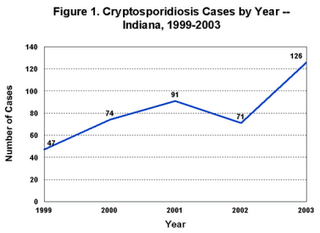
"Cryptosporidiosis represents a classic ‘emerging infection’; previously unknown in such severity, it has become important owing to its potential for fatal outcomes in HIV+ individuals. Since treatments are still in the developmental phase, current control efforts are largely directed at prevention methods."(1)
The Point
One study has indicated that, "on average, fresh fecal material from throughout feedlot systems (recent arrivals to nearing slaughter) contained about 1.3 to 3.6 oocysts/g feces, which roughly translates to about 2.8 x 10⁴ to 1.4 x 10⁵ oocysts/animal per day."(4)
Young calves are the primary source of C. parvum in dairy herds.(2)
Keep in mind, C. parvum oocysts are VERY SMALL, resistant to chlorine and other disinfectants, and survive up to 18 months in cool, damp or wet environments. They are quite common in rivers and lakes, especially where there has been sewage or animal contamination.(1)
The CDC recommends to Avoid water that might be contaminated, as follows:
1. Do not swallow recreational water.
2. Do not drink untreated water from shallow wells, lakes, rivers, springs, ponds, and streams.
3. Do not drink untreated water during community-wide outbreaks of disease caused by contaminated drinking water.
4. Do not use untreated ice or drinking water when traveling in countries where the water supply might be unsafe.
On another section of their site:
Do you want to see a calving CAFO go in so close to a residential area here in Jasper County?
I don't.
Sources:
(1) CRYPTOSPORIDIUM PARVUM - A Review of Cryptosporidiosis
(2) Survival of Cryptosporidium parvum Oocysts in Calf Housing Facilities in the New York City Watersheds
(3) Indiana Cryptosporidiosis Cases by Year -- 1999 - 2003 and Cryptosporidiosis Cases by Month - Indiana, 2003
(4) Environmental Load of Cryptosporidium parvum Oocysts from Cattle Manure in Feedlots from the Central and Western United States
(5) Preventing Cryptosporidiosis: A Guide for People with Compromised Immune Systems
(6) Center for Disease Control (Division of Parasitic Diseases) - Cryptosporidium Infection; Cryptosporidiosis
Other Resources:
- Indiana Department of Health - Cryptosporidiosis 2002
- “Preventing Cryptosporidiosis: A Guide to Water Filters and Bottled Water”
- Release of Cryptosporidium and Giardia from Dairy Cattle Manure
PS: I posted my sources separately instead of embedding the links throughout my post because some people haven't realized the embedded links lead to source info for the educational information I've been posting. I hope that helps them.
PSS: Any information posted in this blog is for educational purposes only and is NOT intended to diagnose, treat or cure any disease... but I'm guessing you already knew that, right?
It's one more reason I want to find out what happens at the - meeting on Monday night Dec. 11, 2006 - 7 pm - at the Rennselaer High School.
And it's just one more reason I feel a calf CAFO should NOT go in anywhere near Wolf Creek, ditches, rivers, streams, lakes -- and most important, the A-2 zoned residential subdivisions surrounding the area where this particular CAFO would like to establish itself.
Here's what C. parvum is.
C. parvum (actually called Cryptosporidium parvum Oocysts) are a common protozoan parasite that causes disease in humans. The pathogenic potential of the parasite was not fully appreciated until 1982.(1)
Water treatment plants cannot usually guarantee to remove all C. parvum from water because the oocysts are very small (4-5 micrometers in diameter) and because it has a thick outer shell, this particular parasite is highly resistant to disinfectants such as chlorine and iodine.(6)
Does this mean you can't kill it?
Not entirely... C. parvum is inactivated by heat, freezing and drying, ...so heat-treated, frozen and dried foods are thought to be safe, according to one study.
However, in water (such as drinking water, rivers, lakes, streams, etc.), freezing temperatures are not adequate for assuring oocyst elimination.(1) The CDC recommends you bring water to a rolling boil for at least 1 minute before using, if you suspect it may be contaminated with C. parvum.(6)
Cryptosporidiosis
Cryptosporidiosis is a parasitic infection (from C. parvum).(2) Both the disease and the parasite are commonly known as "crypto." It can be VERY CONTAGIOUS!(6)
In humans it causes
- abdominal pain,
- profuse diarrhoea,
- weight loss,
- loss of appetite and
- anorexia,
but in otherwise healthy individuals the infection is usually self-limiting and resolves within a few weeks (Soave, 1994). "The symptoms may go in cycles in which you may seem to get better for a few days, then feel worse again before the illness ends."(6)
"In immunocompromised patients the infection is more serious; it can become chronic and is sometimes fatal."(1)
For immunocompromised people there is no cure.(1)(6)
A new drug, nitazoxanide, has been approved for treatment of diarrhea caused by Cryptosporidium in people with healthy immune systems, according to the CDC.(6)
The Indiana Department of Health have indicated that outbreaks have been associated with contaminated drinking water, recreational water venues, consumption of unpasteurized apple cider, and daycare centers. Populations at most risk of developing severe infection include young children, the elderly, and those with weakened immune systems.(2)
Here's a chart which shows reported confirmed cases in Indiana(3):
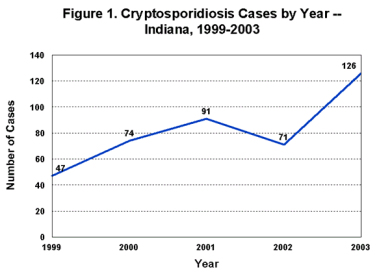
"Cryptosporidiosis represents a classic ‘emerging infection’; previously unknown in such severity, it has become important owing to its potential for fatal outcomes in HIV+ individuals. Since treatments are still in the developmental phase, current control efforts are largely directed at prevention methods."(1)
The Point
One study has indicated that, "on average, fresh fecal material from throughout feedlot systems (recent arrivals to nearing slaughter) contained about 1.3 to 3.6 oocysts/g feces, which roughly translates to about 2.8 x 10⁴ to 1.4 x 10⁵ oocysts/animal per day."(4)
Young calves are the primary source of C. parvum in dairy herds.(2)
Keep in mind, C. parvum oocysts are VERY SMALL, resistant to chlorine and other disinfectants, and survive up to 18 months in cool, damp or wet environments. They are quite common in rivers and lakes, especially where there has been sewage or animal contamination.(1)
The CDC recommends to Avoid water that might be contaminated, as follows:
1. Do not swallow recreational water.
2. Do not drink untreated water from shallow wells, lakes, rivers, springs, ponds, and streams.
3. Do not drink untreated water during community-wide outbreaks of disease caused by contaminated drinking water.
4. Do not use untreated ice or drinking water when traveling in countries where the water supply might be unsafe.
On another section of their site:
If you touch a farm animal, particularly a calf, lamb, or other young animal, or visit a farm where animals are raised, wash your hands well with soap and water before preparing food or putting anything in your mouth.(5)
Do you want to see a calving CAFO go in so close to a residential area here in Jasper County?
I don't.
Sources:
(1) CRYPTOSPORIDIUM PARVUM - A Review of Cryptosporidiosis
(2) Survival of Cryptosporidium parvum Oocysts in Calf Housing Facilities in the New York City Watersheds
(3) Indiana Cryptosporidiosis Cases by Year -- 1999 - 2003 and Cryptosporidiosis Cases by Month - Indiana, 2003
(4) Environmental Load of Cryptosporidium parvum Oocysts from Cattle Manure in Feedlots from the Central and Western United States
(5) Preventing Cryptosporidiosis: A Guide for People with Compromised Immune Systems
(6) Center for Disease Control (Division of Parasitic Diseases) - Cryptosporidium Infection; Cryptosporidiosis
Other Resources:
- Indiana Department of Health - Cryptosporidiosis 2002
- “Preventing Cryptosporidiosis: A Guide to Water Filters and Bottled Water”
- Release of Cryptosporidium and Giardia from Dairy Cattle Manure
PS: I posted my sources separately instead of embedding the links throughout my post because some people haven't realized the embedded links lead to source info for the educational information I've been posting. I hope that helps them.
PSS: Any information posted in this blog is for educational purposes only and is NOT intended to diagnose, treat or cure any disease... but I'm guessing you already knew that, right?
Tuesday, December 05, 2006
Water - Another Reason to attend this CAFO meeting
No matter where you live in Jasper county, there is one MORE VERY IMPORTANT REASON to attend the BZA CAFO meeting coming up Monday night -- 7:00 pm at the Rensselaer High School...
WATER!
Weaned dairy heifers (calves) consume approximately 1 to 1.5 gallons
of water per day per 100 pounds of body weight.
See http://osuextra.okstate.edu/pdfs/F-4275web.pdf
According to "Estimating water requirements" Worksheet 1:
See http://www.oneplan.org/Stock/WaterNeeds.pdf
And Fresh Water Needs for Dairy Farms
See http://www.oneplan.org/Stock/DairyWater.shtml
Heifers (calves) Average Weights Are:
16-24 months - 1050 lbs
13-15 months - 800 lbs
9-12 months - 600 lbs
5-8 months - 400 lbs
3-4 months - 250 lbs
0-2 months - 150 lbs
So... take 13,000 calves in a small area, ranging in weight from 150 to 400 pounds... on an average day, you can expect them to drink anywhere from the bare minimum of 19,500 gallons of water (if they all only drank 1 gal/day and were only 150 pounds or less) to as much as 78,000 gallons of water (if they drank 1.5 gal/day and averaged 400 pounds) --- that's just drinking water -- PER DAY!!
If they were all 400 lbs:
1.5 gal x 400 x 13,000 / 100 = 78,000 gallons PER DAY
1 gallon x 400 x 13,000 / 100 = 52,000 gallons PER DAY
If they were all 250 lbs:
1.5 gal x 250 x 13,000 / 100 = 48,750 gallons PER DAY
1 gallon x 250 x 13,000 / 100 = 32,500 gallons PER DAY
If they were all 150 lbs:
1.5 gal x 150 x 13,000 /100 = 29,250 gallons PER DAY
1 gallon x 150 x 13,000 / 100 = 19,500 gallons PER DAY
You can bump those numbers up anywhere from one to three gallons per day per heiffer on hot days where temperatures reach 80 degrees or higher.
So, on a hot summer day when many farmers are irrigating their crops, you can also see anywhere from 39,000 gallons to as much as 234,000 gallons per day being consumed by the calves.
That's just drinking water.
This does NOT count water required for farm maintenance and other parts of their operation. They will not have lagoons to use recycled water for some of the maintenance water requirements like washing pens, etc. Holding pens with sprinkler cow washers can use an average of 47.1 ± 17.7 gallons per cow per day.
If they are intending to use sprinkler cow washers, you can estimate anywhere between another 612,300 gallons to as high as 842,400 gallons of water used -- PER DAY!!
That's just the heifer requirements. I'm not talking about other water uses for day to day operations here. Okay, maybe those estimates for "maintenance use" aren't on the conservative side, and, since they won't be milking at the operation (?) maybe they won't be cleaning the heifers (or sprinkler cooling them) as much as a full blown Dairy CAFO with milking parlors would have to? Not sure...
About our watershed.
Interestingly enough, the location of this facility will be on top of a very unique split in the bedrock system for the Kankakee River Basin (see Water Availability Maps for the lower basin).
The location sits atop what is known as "Devonian Antrim Shale" -- aka black shale.
The few wells completed in this shale unit can only produce less than 15 gallons per minute (gpm), according to DNR Division of Water. DNR Division of Water also state,
"It is an unlikely source for greater amounts of water."
That's the side we live on. It's also the side where the hog CAFO was built this past year, and which is now sucking out tens of thousands of gallons of our freshwater supply -- PER DAY.
The other side sits atop SILURIAN AND DEVONIAN CARBONATE (limestone, dolomite, and dolomitic limestone). This is the principle bedrock aquifer in the Kankakee basin (over by Fair Oaks) and "the only bedrock aquifer capable of supporting high-capacity pumpage." Many large-diameter wells produce 300 to 1000 gallons per minute (gpm), but small-diameter domestic wells produce 10 to 30 gpm.
Now, the original application for this calving operation indicated:
5,000 calves to be housed in the poultry barns and bubble barns for 8,000 more.
This was replaced, I think(?), with a different application for just 5,000 calves. But there was a different application which in total indicated 10,000 calves.
Confusing, right? In my humble opinion, that's just sloppy paperwork in order to rush this deal through.
You can simply adjust the numbers for water requirements accordingly -- but any way you look at it, that's one heck of a heavy burden on our aquifer!
Keep in mind -- these guys (den Dulks) are already sucking HUNDREDS OF THOUSANDS of gallons of freshwater DAILY from our aquifer over at Fair Oaks.
Maybe they don't know about the bi-State Agreements between Indiana and Illinois regarding this particular watershed.
Maybe they don't know about the water protection laws that were put in place owing to water disputes in Jasper and Newton counties that happened in the past.
Maybe they didn't read the notice sent out to dairy farmers in the midwest warning of drought conditions coming within the next 3 years or less.
Maybe they just don't care?
Personally, I feel they should be paying a water tax (calculated per head of dairy cow) for every single farm they own in Jasper County.
Maybe -- just maybe -- a public official should start counting how many head of cattle they actually house on their farms?
Subscribe to:
Posts (Atom)


 Posts


